
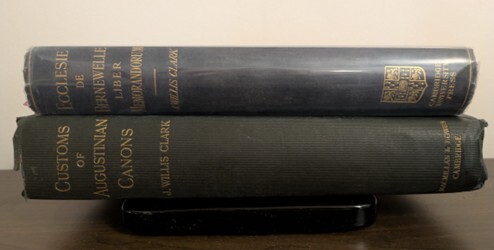
J Willis Clark’s translation of the Liber Memorandum Ecclesie de Bernewelle (1294-95), printed in two volumes (Photo: J Harmon 2025)
1092: The First Foundation by Jac Harmon
The Priory of St Giles was one of the earliest foundations of the Augustinian Canons, arriving in England early after William I’s Conquest. Little is known of its founder, Picot de Grentebruge, sheriff of Cambridgeshire. Even his name is a nickname meaning ‘pickaxe’. However, the story of the priory’s foundation is recorded in the manuscript known as the Liber Memorandum Ecclesie de Bernewelle - now kept in the British Library as part of the Harlian Collection MS.3601. (For ease, this shall now be referred to as the LMB).
Picot’s wife, Hugolina, fell gravely ill, and husband and wife made a solemn vow that should she survive, they would found a priory dedicated to St Giles (Hugolina’s patron saint) as thanks for her recovery. Hugolina duly recovered, and the vow was fulfilled. A Priory to house six Canons Regular and their Prior, Geoffrey of Huntingdon, was built on land between Cambridge Castle, where Picot had his administrative headquarters, and the river Cam. It was endowed with the advowsons[1] of nine local rectories to which Picot added two-thirds of the income of his knight’s barony at Bourn. This sounds generous, but in fact, it gave the small community many churches but little land.
After Picot’s death, his son, Robert, showed little or no interest in the small community of canons. Having been outlawed for participating in a rebellion against the King, possibly that led by Robert Curthose, Duke of Normandy, he was outlawed and died in exile. The Priory was left without any patronage, and the unknown canon who was tasked to write the LMB almost three centuries later lamented how it fell into disrepair.
[1] Very briefly, owning the advowson of a church entitled the Priory to two things: Firstly, all the monies raised from the land attached to it, for instance, the tithes of the parishioners, and secondly, the right to appoint a vicar should the post become vacant. There was a long-running court battle between the Priory of Barnwell and the Vicar of Guilden Morden concerning the advowson of the church, which is covered in some detail in the LMB. I intend to cover this in a future post.
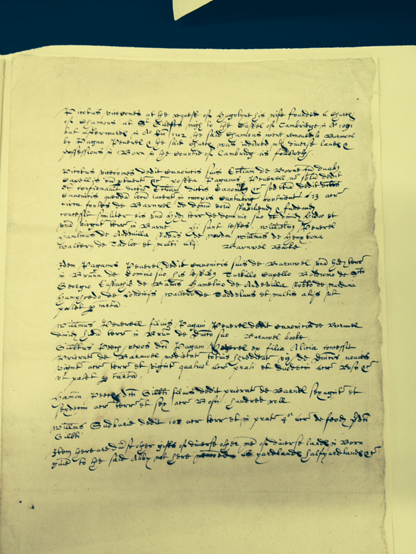
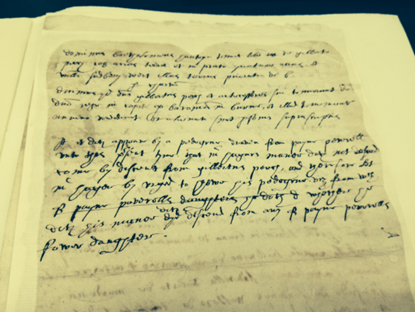
Bourn A (2). Reproduced by kind permission of the Master and Fellows of Christ’s College, Cambridge.
The above document, written in a mixture of English and Latin, begins ‘Picotus vicecomes at the request of Hugolyne his wife founded the Church of Channons of St Gileses [?] to the Castle of Cambridge in A° 1091 etc.’
However, whilst it opens with the sheriff and his wife, this document is far more concerned with a man named Pain (or Pagan) Peverell, the second founder of Barnwell Priory, whom we shall meet in the next post.