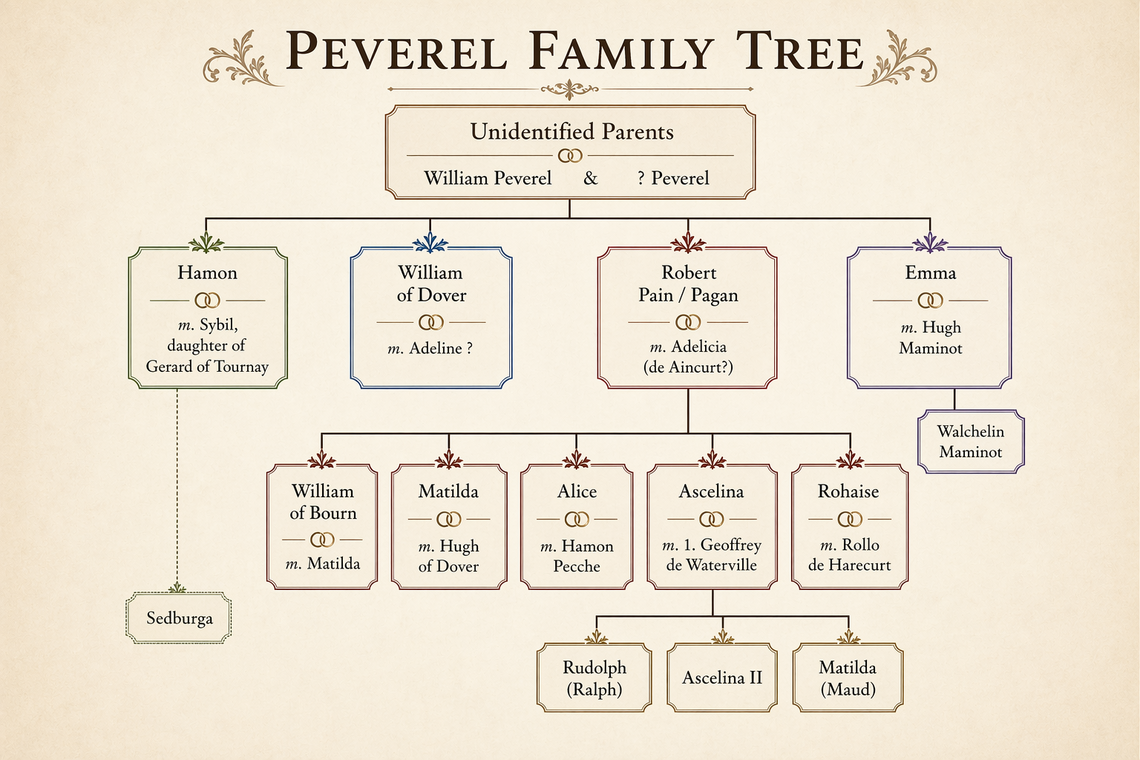
The second patron of Barnwell Priory was Robert (also Pain or Pagan) Peverel. Peverel was a crusader knight who had carried Robert Curthose, Duke of Normandy’s, standard in the Holy Land. Despite the animosity that existed between Robert, William the Conqueror’s eldest son, and his brother, who came to the English throne as Henry I, Peverel managed to remain in favour and was granted the previously confiscated barony at Bourn and its lands. In his new foundation charter for the Priory, Peverel confirmed to the canons all Picot’s original gifts and grants, and to these he added the churches at Landbeach, Trumpington, Haslingfield, and Harlton.
Peverel’s plans for Barnwell far exceeded those of Picot, and for his projected house of 30 canons, he needed more land, so he petitioned the King for a plot of previously common land lying to the East of the town in the Cambridge fields.[1] The land was bounded to the North by the River Cam and included a freshwater spring. It is this ‘children’s’ or ‘bairn’s’ spring that is said to give the area, and subsequently both the Priory and the thirteenth-century suburb that grew up around it, its name.
Religious houses were often placed on, or near, the sites of hermitages, as it was felt that the land was already marked out as a Holy space by their presence. Godesone (as the hermit is named in sources including the LMB[2]) had an oratory dedicated to St Andrew next to the spring. Thus, when the canons were translated to Barnwell, and work started on the new priory church, Peverel dedicated it to St Giles and St Andrew. Sadly, Peverel, whom the LMB describes as ‘an excellent soldier … mighty in strength … and above all the nobles of the kingdom,’[3] and who had gifted the canons with relics from Palestine, died less than ten years after building began, and was buried at Barnwell on the north side of the high altar, leaving his son, William, to continue his work.[4]
William’s story is equally sad, for like his father, he became a crusader knight, but unlike Pain he did not survive the wars and was killed in the Holy Land during the Second Crusade (c.1147-8). His death was to lead to the Barony of Bourn being divided amongst his four sisters, with all other inheritances being shared between his two eldest sisters, Matilda (or Maud) de Dover, and Alice Pecche.
Maud’s death, without an heir in 1185, led to further claims being made by her surviving siblings against her estate, and four charters concerning one particular dispute - that of the advowson of the church at Burton Coggles in Lincolnshire - survive in the archives of King’s College, Cambridge.[5]
Next time … The Priors of Barnwell as described in the LMB.
[1] This ‘privatisation’ of common land was to cause much future contention with the town.
[2] The hermit of Barnwell’s name survives today in Godeson Road, and Godeson Court.
[3] LMB p.41.
[4] The LMB suggests c.1121X1122, but this is unconfirmed by any charter evidence. A royal charter c.1129 shows Pain Peverel witnessing a grant of land at Great Shefford (Berkshire) to his daughter, or niece, Matilda, on her marriage to Hugh, son of Fulbert of Dover. Another extant charter also mentions a Pain Peverel active in c.1133.
[5] The subdivisions led to one of the most complicated descents I have researched - a story to be tackled in a future post.