by Nigel Woodcock, Department of Earth Sciences, University of Cambridge
Although St Andrew the Less has been much repaired during the 19th and 20th centuries, some of its walls and dressings still date from the 13th century. It is typical of medieval churches in using locally available stone as far as possible. The motive for this choice was economic. Until the coming of the railways in the mid-19th century, every 10 miles of overland transport doubled the cost of the stone at the quarry gate. Transport by inland waterways, the predominant medieval transport mode, doubled the stone cost in 50 miles, but still made local materials more attractive.
There is just one sort of local stone in the church:
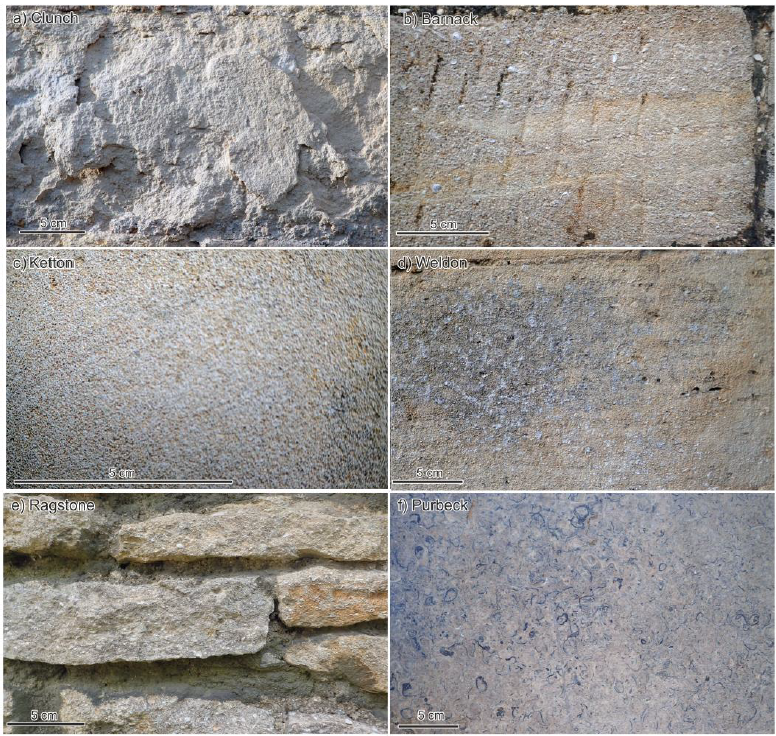
White Clunch – the harder beds from the local Chalk Group, a very fine-grained white limestone (Fig. 1a).
The main local Chalk unit suitable for dressing to shape is the Totternhoe Stone, also known locally as Burwell Rock, of earliest Late Cretaceous age (101-94 Ma). This stone was indeed quarried at Burwell and Reach, about nine miles northeast of Barnwell, and easily carried by water from there to Cambridge. Less likely sources were near Barrington, seven miles by water to the southwest and at Limekiln Hill (Cherry Hinton) two miles by road to the southeast.
Clunch was used in St Andrew the Less both for walling and for dressings but was not durable enough for satisfactory use in exposed dressings such as sills, plinths and buttresses. Therefore, more weather-resistant stone had to be imported from further afield. St Andrew’s contains stone from at least three quarries in the Lincolnshire Limestone Formation of Mid-Jurassic age (170-168 Ma).
The nearest source of this stone is in the Stamford area, over 40 miles to the northwest of Cambridge. The prohibitive medieval overland transport costs were avoided by shipping the stone on inland boats. Until the Fens were drained in the 17th century, there was an interconnected system of meres and canals that provided a short cut from the rivers Nene and Welland to the Ouse and Cam. Shallow-draught boats could then be brought from near the quarries to a wharf close to St Andrew’s, along what is now Riverside.
One variety of Lincolnshire Limestone was used in the medieval fabric of St Andrew’s:
Barnack – a light brown limestone containing prominent shell fragments, spherical millimetre-sized carbonate grains called ooids, and larger, more irregular, amorphous pellets (Fig. 1b). Barnack, three miles east-southeast of Stamford, was the main Lincolnshire Limestone quarry exporting stone beyond its local area from Roman times until the quarries were worked out by about 1500. Having been exposed to the Cambridge weather for at least half a millennium, Barnack has been partly dissolved along the original sedimentary bedding surfaces to give a characteristic etched appearance. Barnack stone is used in St Andrew’s only for selected exposed dressings; some C13 windowsills, the 14th century window in the south chancel, and the plinths to buttresses and walls. Blocks of Barnack ashlar are recycled into the north wall, repaired in 1854-56, and into the repaired south wall.
Two further varieties of Lincolnshire Limestone were used in the 19th and 20th century repairs and additions.
Ketton – a yellow-brown limestone composed entirely of 1mm-sized spherical ooids and favoured for its very even texture and ease of carving (Fig. 1c). It was exported to Cambridge, mostly by water, from the quarries four miles west-southwest of Stamford from the early 17th century. Probably in 1854-56, Ketton was used for partial refacing of the north and south walls, for wholly replacing the lancet windows in the south wall and replacing the lancet sills in the west and north walls. In 1929, Ketton was used in walls and dressings for rebuilding the south porch. Occasionally, a few small shell fragments are interspersed with the ooids, suggesting that some of the “Ketton” stone came from nearby quarries to the east, near Casterton or Stamford itself.
Weldon – a white ooidal limestone with a higher content of shell fragments than Ketton (Fig. 1d). It has characteristic holes where the ooids have not filled the whole space within or under curved shells. The Weldon quarries, 39 miles west-northwest of Stamford, were not well connected to the medieval river system and only started to be used in quantity in Cambridge after the railways arrived in 1847. Weldon was used in the ashlar walls of the 1928 south porch and for the ashlar west wall and window and door dressings of the 1955 choir vestry.
Shelly limestone rubble (Ragstone, unknown source) – the 1955 choir vestry has north and west rubble walls of irregular elongate pieces of coarsely shelly, oolitic limestone (Fig. 1e). It is likely to be from one of the thin units in the Middle Jurassic of the Stamford area other than the Lincolnshire Limestone; the Cornbrash is a possibility.
Finally, there is one ornamental stone used internally for 13th-century decoration.
Purbeck Marble – a brown, conspicuously shelly, hard limestone that takes a polish (Fig. 1f). The rock is from the late Jurassic/early Cretaceous Purbeck Group (152 to 139 million years old) from the south coast of England. The shells are distinctive Viviparus snails. Purbeck marble was used for monuments and minor architectural details throughout the 12th to 16th centuries.