
Considering the long period of neglect the building has endured, it is striking that St Andrew the Less houses an exceptional, Grade I listed Victorian pipe organ. The instrument was the gift of Sir John Sutton (1820–1873), a benefactor and scholar of the organ. In 1863, Sutton commissioned Hill & Son to build the organ and engaged William Butterfield, the leading Gothic Revival architect, to design its oak case.
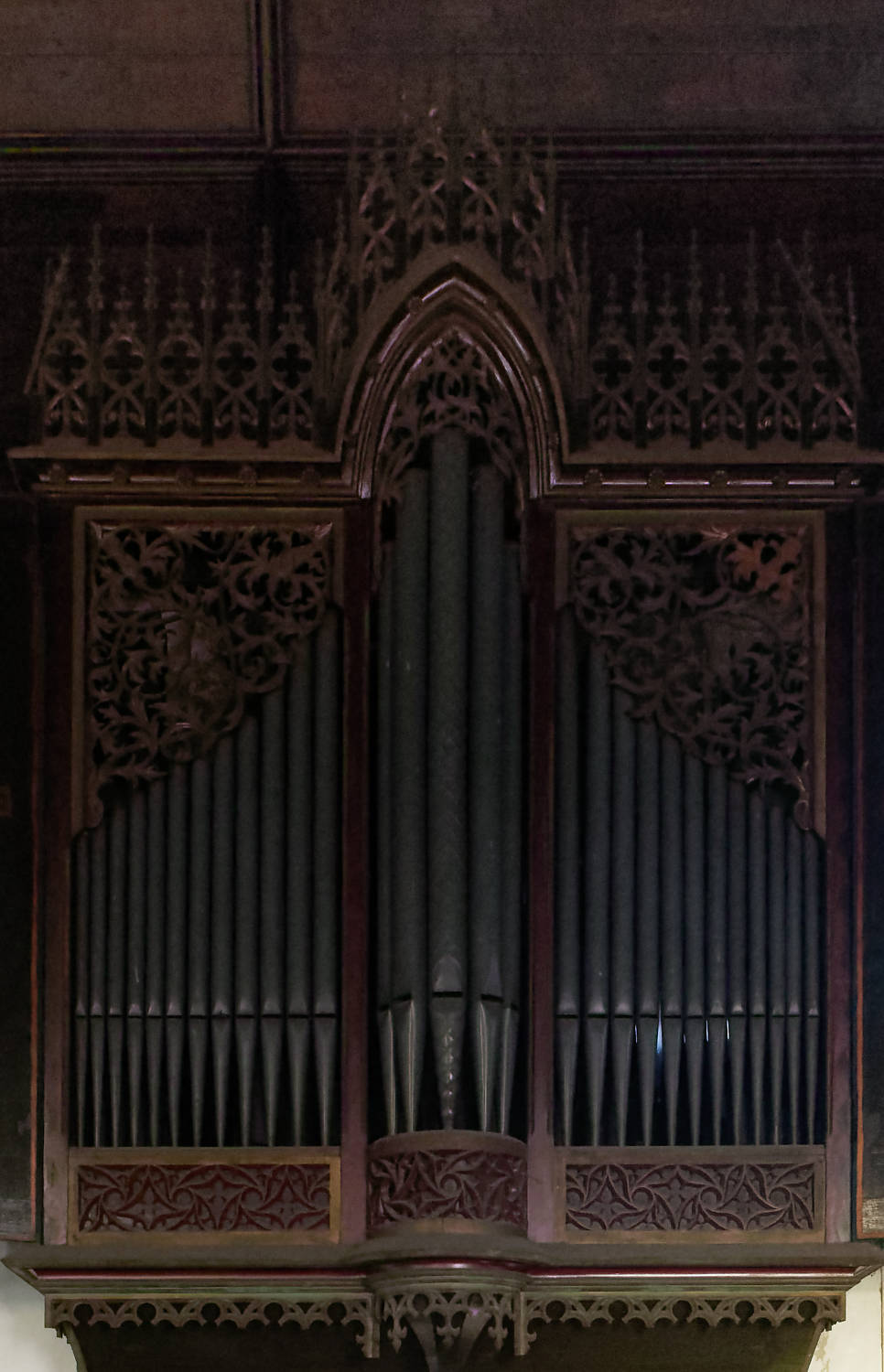
In Sir John Sutton: A Study in True Principles (1992), C. Hilary Davidson places the St Andrew the Less organ within Sutton’s broader organ‑building world, which spans England, Belgium, and Germany. She draws parallels with European examples to illuminate his stylistic influences that can be seen in our organ’s three‑tower façades, carved panels and gothic motifs. It is pleasing to know that these comparisons demonstrate that the organ at St Andrew the Less belongs to a trans‑European design lineage, and is not an isolated parish instrument. And indeed, there are two similar Sutton organs closer to home: one, in a far better condition than ours, at in Jesus College Chapel, and another with Sutton influence (and a strikingly similar case, though not in its original position) in Harlton Church.
There have been two conservative restorations, in 1892 and 1925. Though it seems to have been electrified in the 1950s, as there is no electricity in the building at the moment, so to be played, someone needs to climb into the organ loft and handpump the bellows. This also means that the organ is not in the best of conditions. Local musician Simon Brown very kindly tested out the organ and provided us with the following report:
The main case (including front pipes) seems to be in good condition, and just needs a light dusting. It was obviously built to a high standard, and has stood the test of time well… The pipe-work seems to be in a fair condition, although badly in need of a tune. I only tried the 8’ Open and Stopped Diapasons, the 4’ Principal and the Pedal Bourdon, and they all seemed OK. The keyboard and pedals are functioning, though very uneven in touch.
The mechanism behind the keyboard (parts of which can be seen) is in a parlous state, and probably was before the church was deconsecrated. There were two ciphers (sticking notes) whilst I was playing – one permanent and one intermittent – with the likelihood of several more if the instrument was played regularly. This effectively makes the organ unusable at the present time.