by Nigel Woodcock, Department of Earth Sciences, University of Cambridge
We now take a geological walk around the outside of the church, starting at the east end and working clockwise around the building.
The external east wall of the chancel has walling best described as Clunch rubble (Fig. 2).
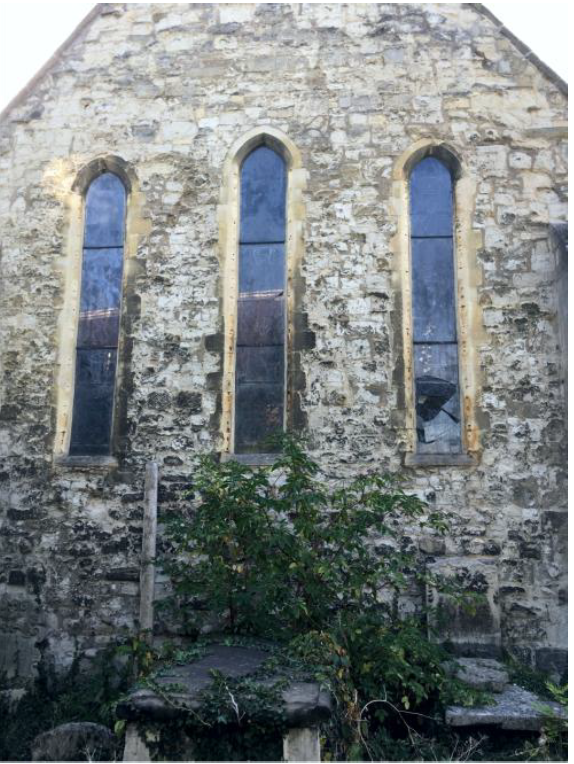
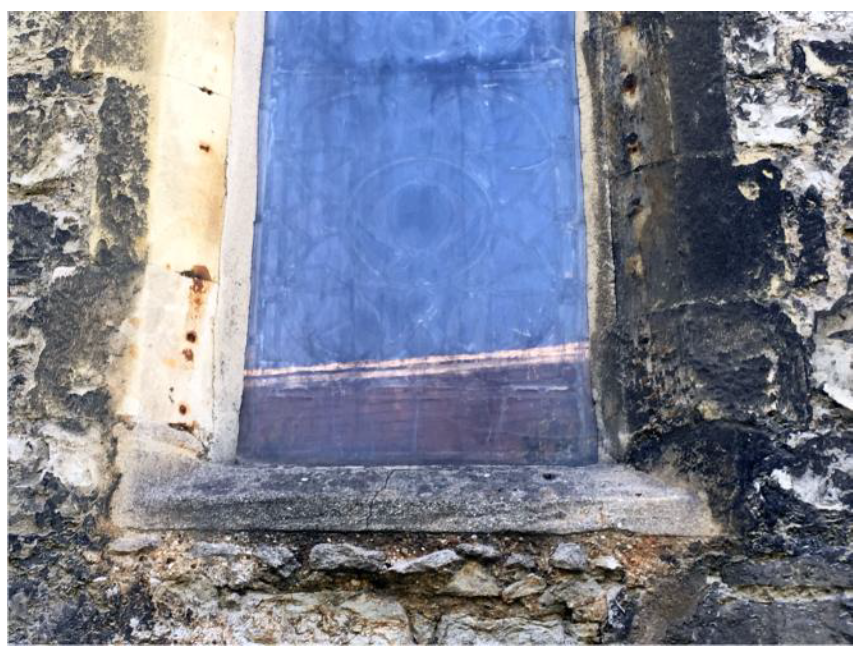
However, many of the Clunch blocks are quite well squared and fitted to adjacent blocks. Although most blocks are badly weathered, parts of some blocks retain remnants of a smooth outer face suggesting that the wall was originally laid as ashlar. This wall dates back to the 13th century (Royal Commission on Historical Monuments, England 1960, p. 263) and there is no evidence that this is not still the original fabric. The three lancet windows are of Clunch with Barnack sills (Fig. 3). The jambs have been replaced by more Clunch, the arches possibly by Ketton.
Moving clockwise, the upper 4 metres of the south wall of the chancel and nave are of the same Clunch rubble as the east wall (Fig. 4).
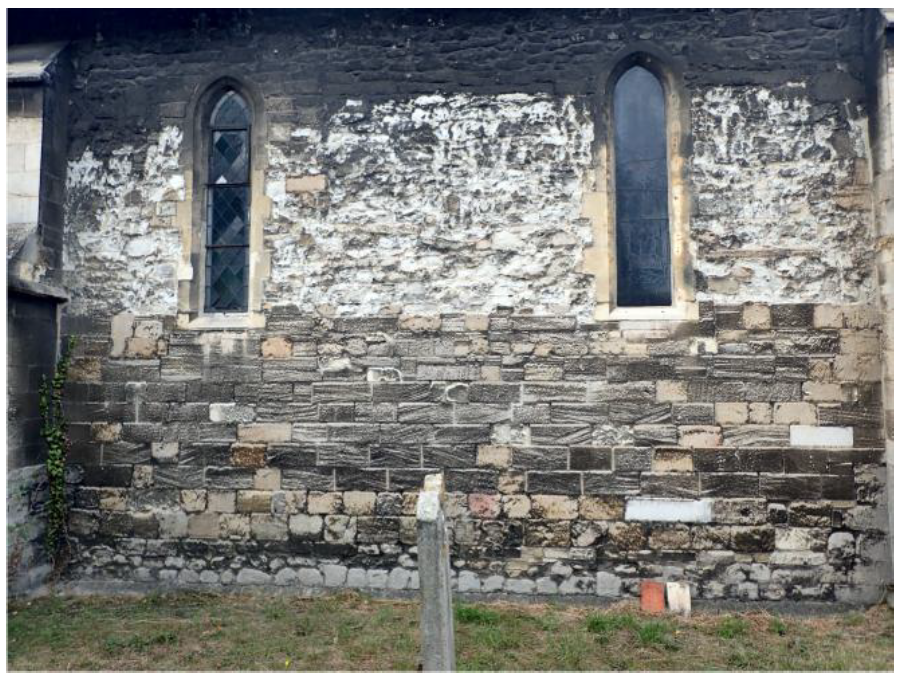
The uppermost metre is probably soot-blackened Clunch but looks less weathered, because of the sheltering effect of the eaves. The base of the wall has a few centimetres of chamfered Barnack, forming a set-off between a buried plinth and the rest of the wall. That wall begins with 20-30 cm course of roughly dressed Barnack overlain by 2 metres of refacing, mostly in Ketton ashlar but with interspersed blocks of ashlared Clunch, reused Barnack, and a green brown fine sandstone. The refacing probably dates from the 1854-56 restoration project. The Clunch blocks in the refacing are already deteriorating badly and the subtle bedding in the Ketton blocks is picked out by variable degrees of soot blackening.
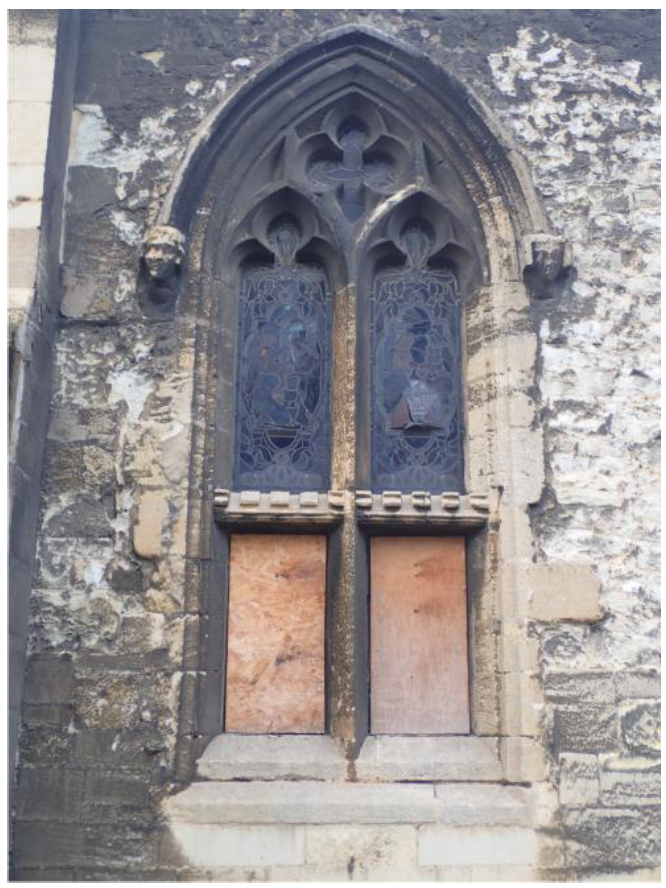
The south wall of the church has angle buttresses at the southwest and southeast corners, and two further buttresses at a third and two-thirds of the distance along the wall. All buttresses have a Barnack ashlar plinth and lower courses to about a metre then Ketton ashlar for the overlying quoins. The Ketton probably replaced Clunch ashlar, some of which survives as infill between the quoins. The 13th-century lancets are now Ketton, probably replacing Clunch and possibly a Barnack sill. The late 14th-century window in the chancel is entirely of Barnack, an expensive exception to the generally modest-cost character of the rest of the church (Fig. 5).
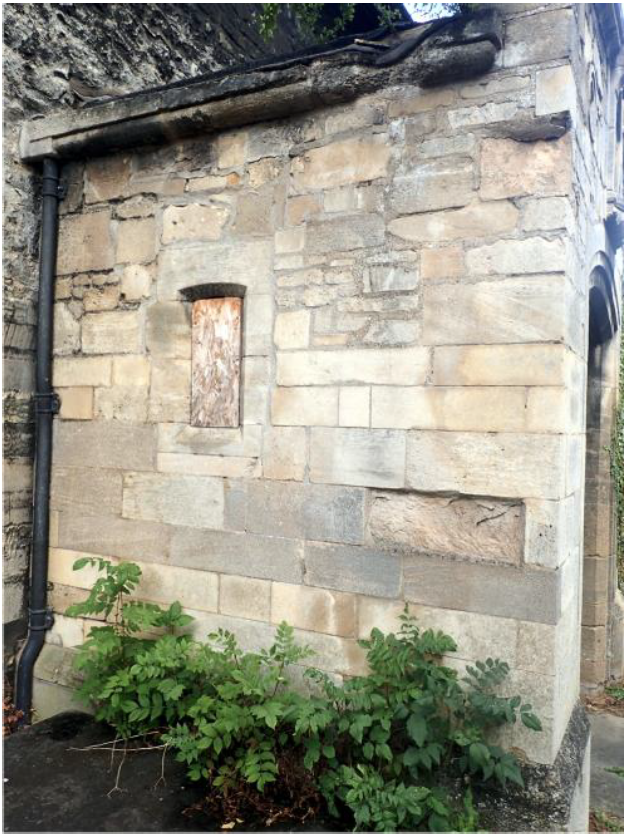
The south porch was rebuilt in 1929. The ashlared walls are of Ketton and Weldon blocks, with sporadic blocks of Barnack, presumably reused from the previous porch, known to be pre-1745 and therefore probably medieval (Fig. 6). The windows and door are of Weldon with some possible reused Barnack in the eastern door jamb.
The west wall of the nave has similar masonry to the south wall. A few courses of roughly dressed Barnack are overlain by 2 metres of refacing, mostly in Ketton ashlar – some blocks soot-blackened – but with interspersed blocks of deteriorating ashlared Clunch (Fig. 7).
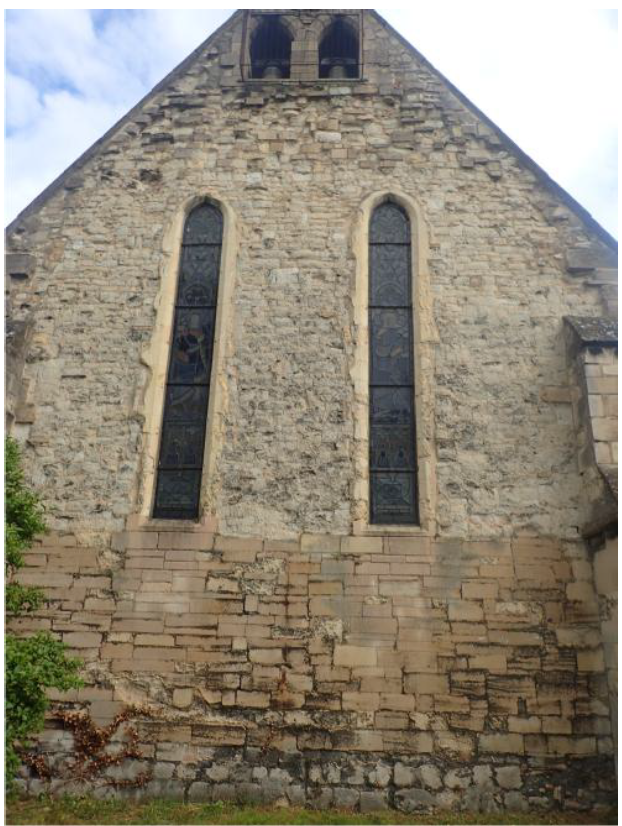
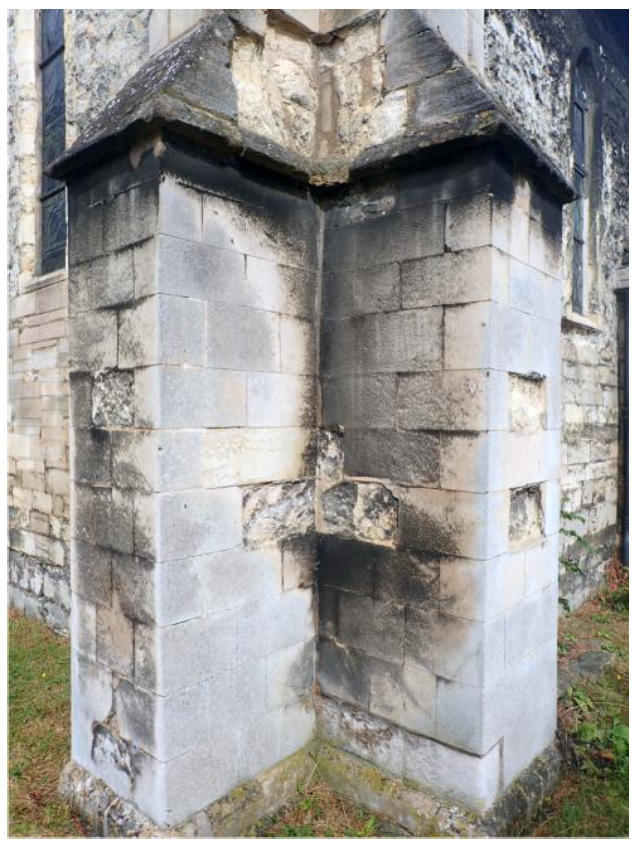
The upper part of the west wall is apparently of Clunch rubble but with squared blocks that suggest it was laid as ashlar. Above the top of the lancets, the Clunch walling has been repaired with inset limestone blocks, probably Ketton. The buttresses flanking the west wall match those on the south wall of the church in having metre-high Barnack ashlar plinth and lower courses then Ketton ashlar for the overlying quoins with some surviving Clunch ashlar infill between the quoins (Fig. 8).
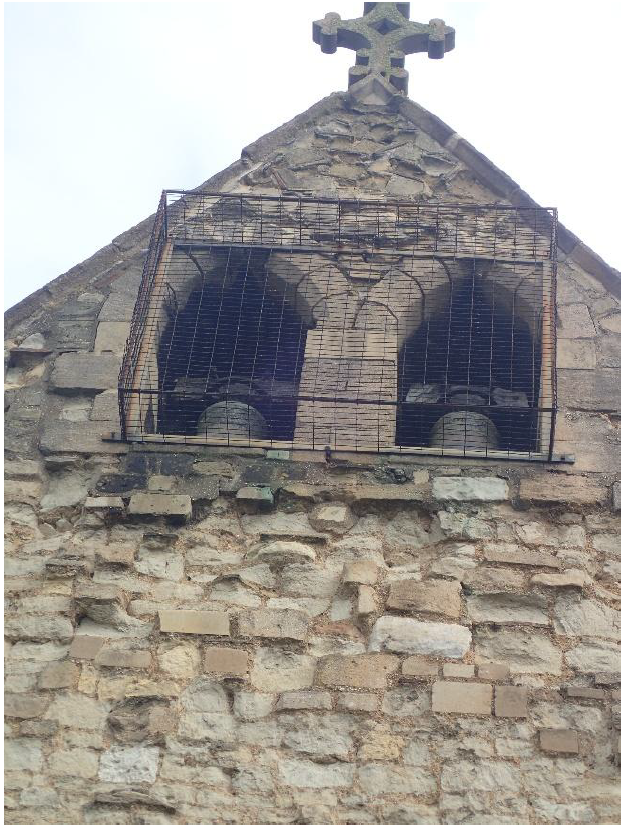
The lancets in the west wall of the nave have been totally replaced in Clunch with Ketton sills. This contrast suggests that the 13th-century originals were Clunch with Barnack sills as at the east end of the chancel. The bell openings in the top of the gable are said to be ‘modern’, that is post-1850 (Royal Commission on Historical Monuments, England 1960, p. 264). The arches and imposts are a fine-grained limestone, possibly Ketton. However, the jambs, mullion and sill are a coarser-grained limestone, probably Barnack (Fig. 9). These components could have been reused from a demolished bell turret, known to have been present in 1745 (Royal Commission on Historical Monuments, England 1960, p. 263).
The north wall of the chancel and nave was substantially rebuilt in 1854-56. The Royal Commission on Historical Monuments, England (1960, p. 263) states that only the upper part was rebuilt and that the lower part was refaced. However, it is evident that the whole wall, or at least its outer skin, has been rebuilt in the same distinctive and inelegant style (Figs 10, 16).
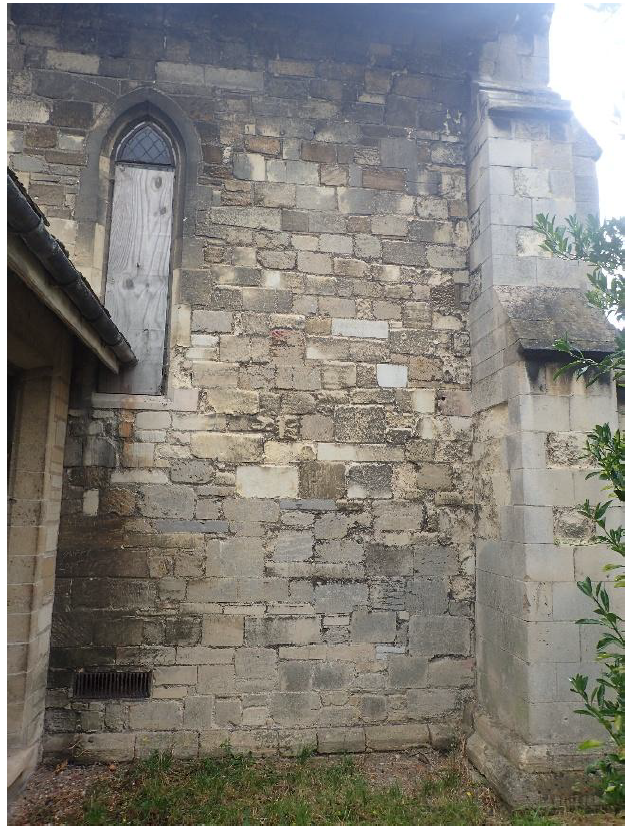
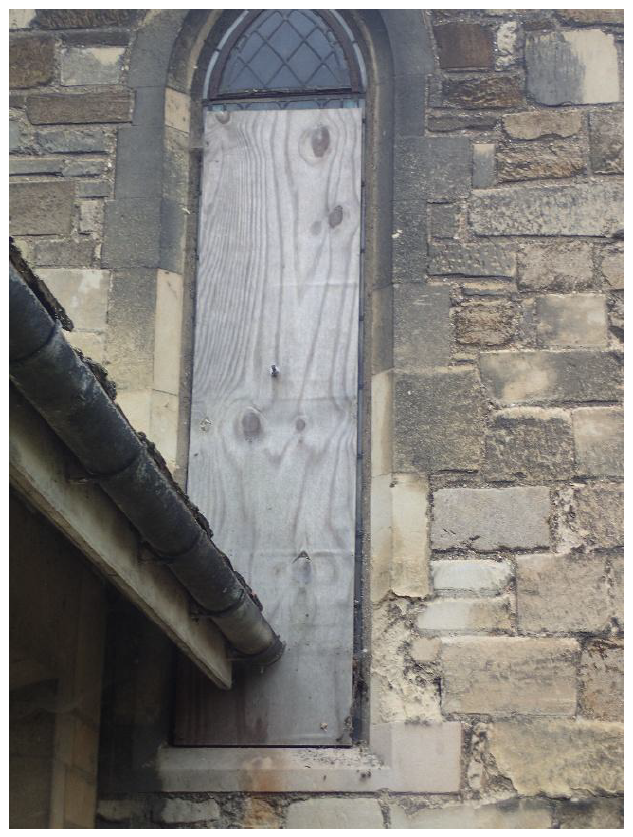
The wall is a mix of face-smoothed (ashlared) blocks of fine-grained, light grey Clunch, medium-grained yellow-brown Ketton, coarse-grained brown-grey Barnack and other unidentified stones. The blocks of Barnack tend to occur in the bottom metre, suggesting that they formed a plinth to the 13th-century wall to match that on the south wall. Above the Barnack-rich zone, the various stone types are randomly distributed. The edges of blocks throughout the wall were once dressed square but now tend to have chipped edges and corners suggesting reuse from a previous wall. The coursing of the masonry is imperfect, and snecking (where one block laterally abuts two blocks) is common (Fig. 10). The three surviving buttresses along the north wall match those on the rest of the church in having Barnack ashlar plinths then Ketton ashlar for the overlying quoins with some surviving Clunch ashlar infill between the quoins. The five lancets in the north wall have been totally replaced in Clunch with Ketton sills; the Clunch is decaying in places and is partly replaced by Ketton (Fig. 11).
The choir vestry, built in 1955 (Royal Commission on Historical Monuments, England 1960, p. 263), abuts the north wall of the nave, opposite the south door. The west wall is a mix of Ketton and Weldon ashlar, with a Weldon door surround (Fig. 12).
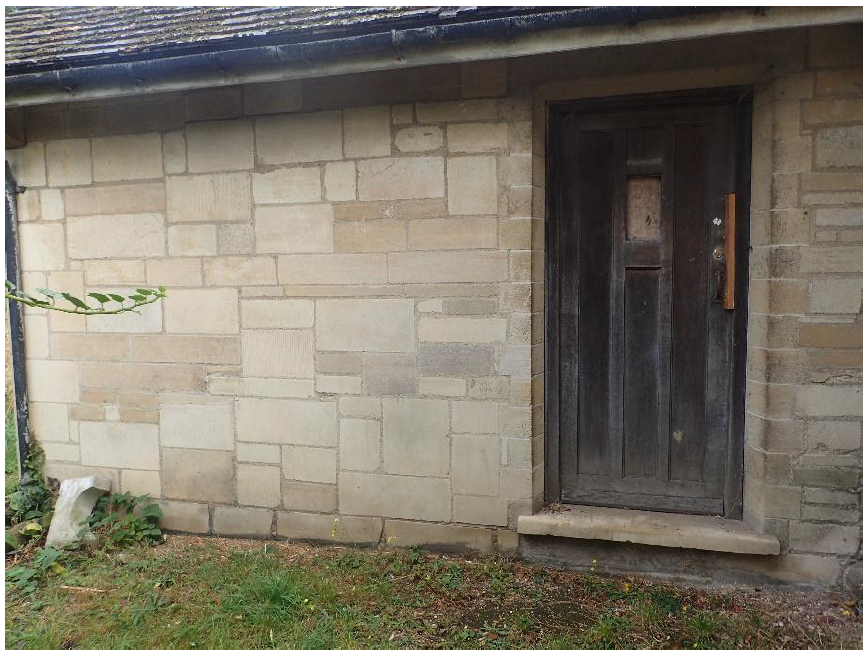
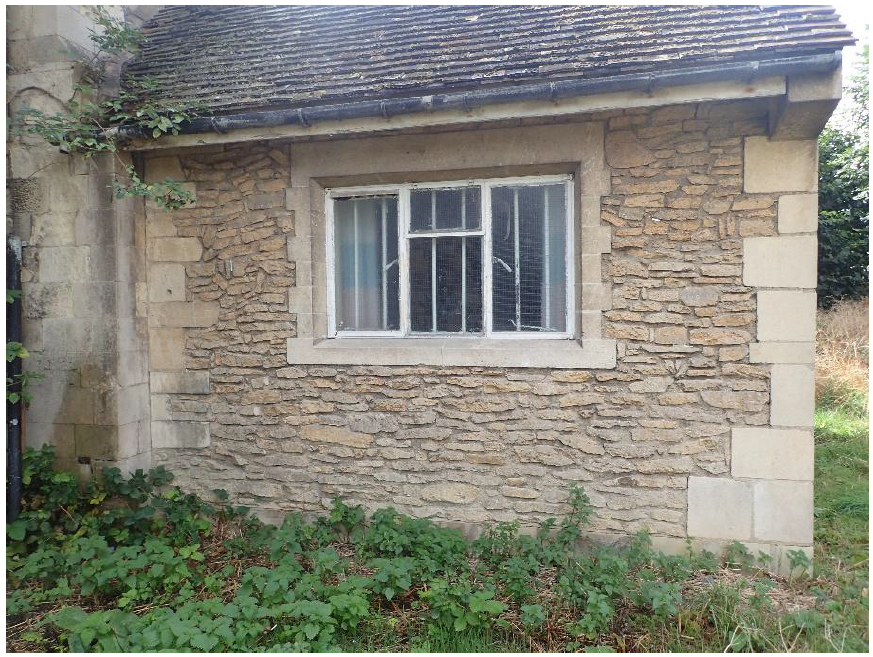
The walling is heavily snecked and, like the nave walls, features disturbing examples of vertical joints running across two or three courses. The north and east walls are of ragstone rubble, the stone being a hard-cemented shelly ooidal limestone, presumably from the Lincolnshire Limestone, but difficult to specifically identify (Fig. 13). The elongate pieces are laid inelegantly, with undulating sub-horizontal courses broken by disorganised slanting and vertical pieces. The eastern window is of Weldon.
The vestry/organ chamber was added to the north wall where the chancel and nave join ‘in the later 19th century’ (Royal Commission on Historical Monuments, England 1960, p. 263). However, the style of masonry and mix of stone for the walls is the same as for the north wall, and the lancet window in the east wall is similarly Clunch with a Ketton sill (Figs 14, 15). It seems likely therefore that the vestry/organ chamber was built at the same time as the main north wall was rebuilt in 1854-56.